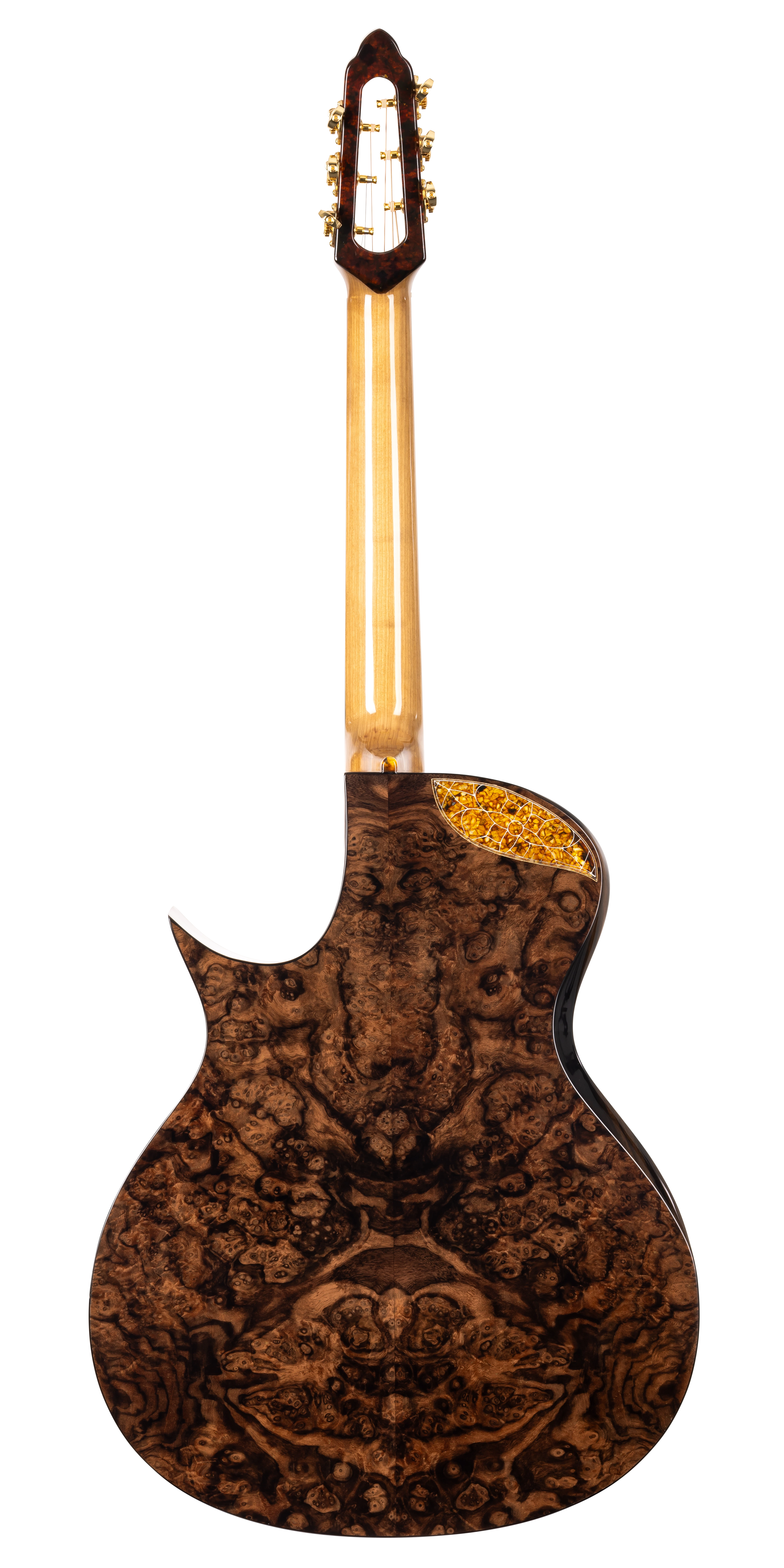
Acoustic Resonance System
Resonance begins beneath the surface.
Inside the design
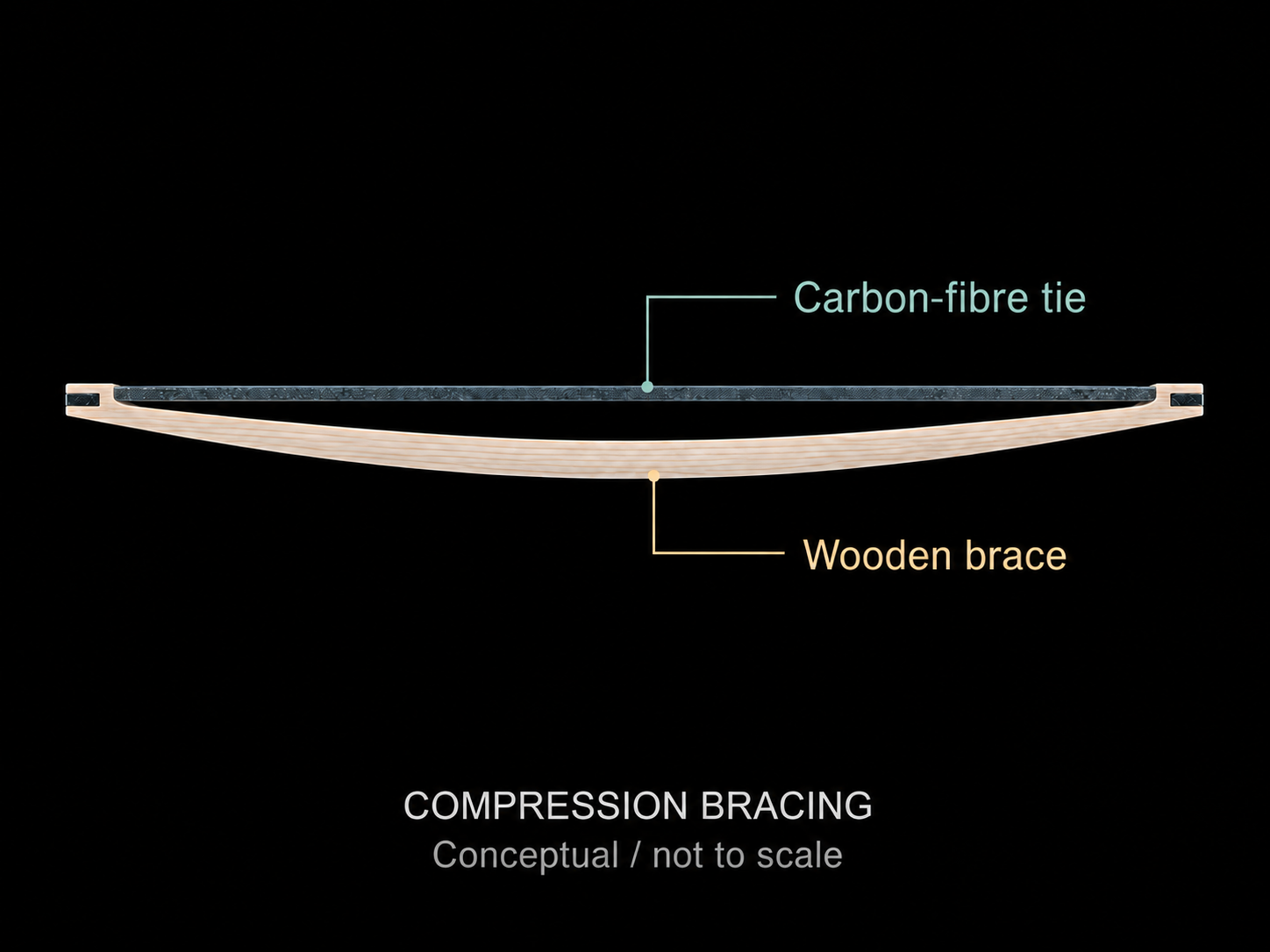
Arched wooden braces with carbon-fibre ties maintain the back's curvature and increase its stiffness. Compression Bracing is a construction for the back of the guitar, not the soundboard.
Compression Bracing is available only on selected models. It is not part of our standard specification; its inclusion is confirmed individually for each instrument.
The braces are made from radially sawn Alpine spruce, combining low density with high stiffness along the grain. The wooden braces are formed to their intended curve from the outset.
Each carbon-fibre tie is seated and secured at the ends of the shallow wooden brace. Spruce provides the lightweight arch; carbon fibre helps resist its ends moving apart. The materials work together to stabilise the curve as part of a rigid back construction.
It connects the ends of the wooden brace to help maintain its curvature and increase stiffness. The tie is seated in the wooden ends as part of a rigid back construction. The illustration separates the elements schematically to make these end connections visible; it is not a dimensional drawing.
No. Compression Bracing describes the back construction. The soundboard has its own structure and is considered separately.
Examples include the two Modern guitars marking Turkowiak Guitars' 40th anniversary: the steel-string acoustic No. 791 and the nylon-string No. 792. Compression Bracing is available only on selected models, not as a standard feature. Its inclusion is confirmed in the individual instrument specification.
We use radially sawn Alpine spruce for its combination of low density and high stiffness along the grain. This gives the wooden arch a favourable stiffness-to-weight ratio, helping keep the structure light. Resonance-grade spruce can also have low internal damping, so relatively little vibrational energy is dissipated within the wood. These properties vary between pieces and with grain direction and moisture; Alpine origin alone is not a guarantee of performance.
Carbon-fibre composites offer high tensile stiffness and strength relative to their mass. In this construction, the tie helps resist the ends of the spruce arch moving apart, supporting the intended curvature without relying on a bulky wooden brace. Fibre direction, resin, cross-section and end connections all influence the finished component; the properties of an individual carbon fibre are not the properties of the whole brace.
Mass, stiffness and damping together shape the back's vibration and its interaction with the rest of the guitar. Mechanical impedance describes the relationship between applied force and vibration velocity at a given frequency; neither a higher nor a lower value is universally better. Here the aim is a stiff, lightweight back structure, not to maximise the back's own sound radiation. Volume, sustain and tonal balance depend on the complete instrument, not on a material ratio alone.
Conceptual single-brace illustration, not to scale. This is not a workshop photograph. Separation and end connections are shown schematically for clarity; it does not show the number, spacing or dimensions of the braces in No. 791.
Considered together
Resonance begins beneath the surface.
A complete soundbox. Light by design.
Your instrument
The right combination begins with your playing. Construction, materials and optional details are confirmed in your individual specification.
