Acoustic Resonance System
Resonance begins beneath the surface.
Sound & construction
A structural detail, drawn in a single curve.
Discover the designInside the design
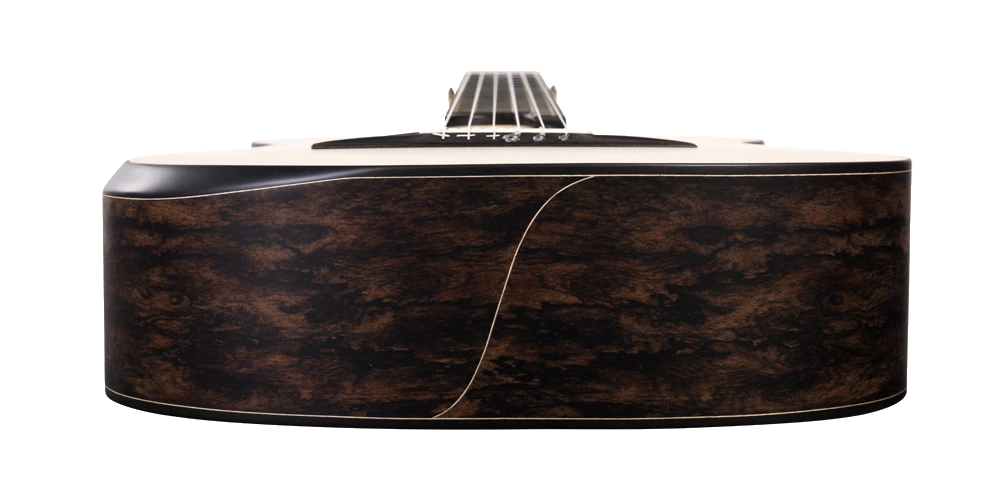
At the tail of the guitar, the sides meet along a continuous S-shaped line. The longer, curved joint spreads load transfer over a broader region instead of concentrating it along a short, straight seam.
This geometry lets us use a smaller, more delicate internal reinforcement. Less material at the joint means lower body mass and less concentrated stiffening, while the reinforcement and bonded surfaces still carry the structural load.
The top, sides and back vibrate as a coupled structure. Avoiding an unnecessarily heavy, rigid patch at their connection is part of managing that coupling. The visible curve is therefore both an elegant joint and a functional part of the lightweight body.
Look at the end of the body, below the bridge. The curved joint can be seen in the side wood in the photograph.
Mechanical impedance describes the relationship between force and vibration velocity. A joint's mass and stiffness affect that relationship locally, and therefore how the body's vibration modes interact. Our aim is a secure connection with less added mass and a less abrupt stiffness change, not a one-way path through which sound travels around the guitar.
It is designed together with the curved contact area, material and body shell. The smaller reinforcement is a consequence of the complete joint geometry, not simply a conventional joint with its support removed.
The photographed instrument has its own specification. Decorative inlays and individual artwork are optional and quoted separately.
Considered together
Resonance begins beneath the surface.
A complete soundbox. Light by design.
Your instrument
The right combination begins with your playing. Construction, materials and optional details are confirmed in your individual specification.
